With the generous support of our community, Team Titin awarded $50,000 over two years to Isabelle Richard, PhD, Principal Investigator and Head of the Progressive Muscular Dystrophies Laboratory at Genethon. Dr. Richard conducted this work in collaboration with Sonia Albini, PhD, and Edoardo Malfatti, MD, PhD.
Their project, “Generation and characterization of skeletal muscle organoids from TTN patients’ iPSC for therapeutic screening,” has now reached the conclusion of its Team Titin funding period. We are pleased to share an update on the important progress made through this award.
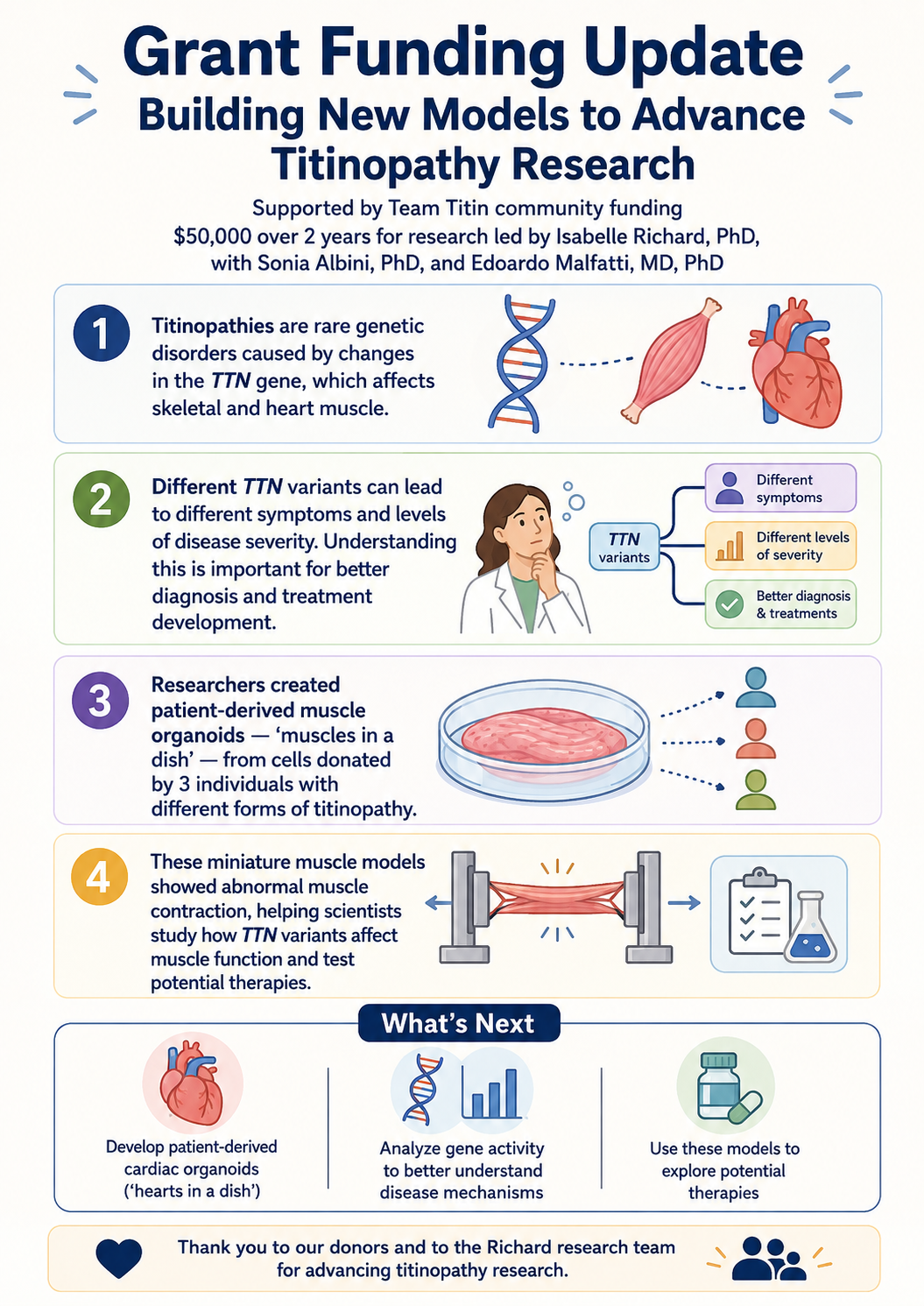
Titinopathies are rare genetic disorders caused by changes in the TTN gene, which provides instructions for making titin, the largest protein in the human body and an essential component of both skeletal and heart muscle. Hundreds of different TTN variants have been identified, but researchers are still working to understand why different genetic changes can lead to such a wide range of symptoms and disease severity. This knowledge is essential for improving diagnosis and developing more targeted treatments.
As a first step, the research team successfully created patient-derived muscle organoids, sometimes called “muscles in a dish”, using cells donated by three individuals with different forms of titinopathy. These miniature muscle models showed abnormal muscle contraction, closely reproducing an key feature observed in patients. This demonstrates that the organoid platform can meaningfully model titinopathy and provides a valuable tool for studying how specific TTN variants affect muscle function and for testing potential therapies.
Building on these promising results, the team is expanding its work to develop patient-derived cardiac organoids, or “hearts in a dish,” to better understand how TTN variants can cause cardiomyopathy, a serious heart condition affecting many people with titinopathies. By combining these advanced disease models with comprehensive analyses of gene activity, the researchers aim to define the molecular mechanisms underlying different forms of titinopathy and uncover new treatment targets. Ultimately, this integrated approach may help pave the way toward more precise and personalized treatments for people living with TTN-related conditions.
We extend our sincere gratitude to Dr. Richard, Dr. Albini, Dr. Malfatti, and the entire research team for their dedication to advancing our understanding of titinopathies. We are equally grateful to every donor and supporter whose generosity made this research award possible. Together, our community is helping to build the scientific foundation needed to better understand TTN-related conditions, evaluate potential therapies, and bring meaningful progress closer for those affected by titinopathy.